
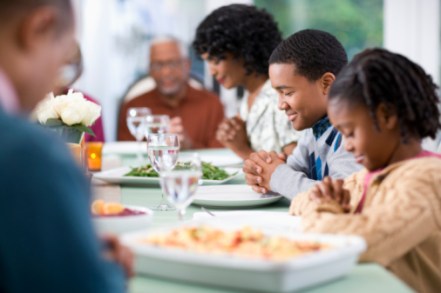
This Thursday millions of Americans will sit down with others to enjoy a time of reflection and thanksgiving. Like our Canadian cousins who celebrated Thanksgiving dinner in October, many of us will share a meal around a table with family and friends. Millions of others will sit across from strangers to partake of turkey, potatoes, and other accouterments thanks to the institutional compassion of The Salvation Army and other churches and missions. Sadly, some will eat alone or not at all. Giving thanks has always been a hallmark of American life at this time of year since before the nation was founded. It remains tethered to the story of Native Americans and undocumented aliens (Pilgrims at Plymouth) sitting down to share a time of feast and fellowship.
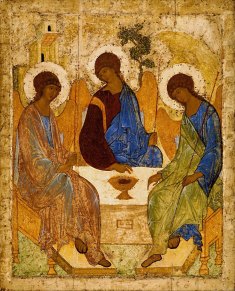
The beauty of Thanksgiving includes the idea of inviting others to the table. It is a special time of holiday (from the root: holy day). It is a time of hospitality and self-giving love for one another; a time of appreciation for blessings too often unnoticed and unacknowledged throughout the year. It is a time to remember the source from whom all blessing flow, the triune God of perfect unity and holy love who daily invites us to a table of divine fellowship, into the presence of the Father, Son, and Holy Spirit. God in three persons, blessed Trinity, invites us to the table of fellowship and waits our response. Thanks be to God!

 We are social beings easily affected by the presence of other persons – by people with whom we are not competing and with whom there are no rewards or punishment, and in fact with whom they do nothing except be passively present. One hundred and eighteen years ago, a psychologist, Norman Triplett (1898), noticed that cyclists times were faster when racing together than when racing alone against the clock. He noticed the same result with children winding string faster on a fishing reel along with others than when winding alone. Triplett, a pioneer social psychologist, is credited with the beginning of research into what eventually became social facilitation theory. The theory states that the presence of others liberates latent energy and improves performance. That’s not always the case. Sometime the presence of other diminishes performance. Later studies showed that the presence of others arouses dominant responses enhancing easy behaviors and impairing difficult ones.
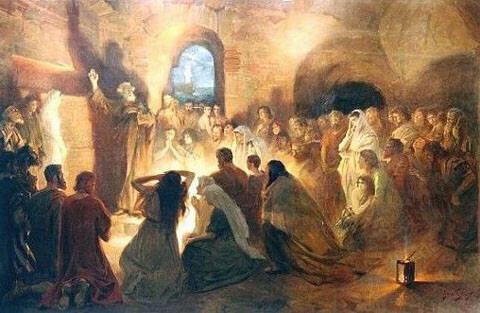 To truly know the love of God is not merely an academic, theoretical idea or engaging proposition. It is more. It is to have knowledge that surpasses knowledge, a knowledge of the heart. Such knowledge comes from being in the presence of the saints, others who walk, and talk, and love one another in holiness. This is the “what” of Paul’s prayer. Then he prays the “why” – “that you (too) may be filled (like all the saints) to the measure (Christ) of the fullness of God,” in other words that you may be holy; holy in the presence of all the saints with complete knowledge of the magnitude of God’s love in true holiness and righteousness. All the saints increasingly know the extent of God’s love. In the fellowship of saints, it is clear, knowable, visible, obvious in who they are and how they live in loving God with a profound love; loving others in ways that are immeasurably more than one might imagine (Eph. 3:20), all to the glory of God.
 Like the banks of the river, when we commit ourselves to the constraining love of Christ, such discipline occasions habits of the heart. Such habits constrain us. Jesus’ commitment to the love of the Father resulted in three disciplined habits: 1) He read the Word of God. Luke’s gospel (4:16) reads that it was his custom to go to the synagogue on the Sabbath where he would stand up and read the scriptures. 2) He frequently sought solitude to pray. “He went into the mountain to pray as was his custom.” And 3) He shared what he had and what he gained through the Scriptures and prayer. In John 17:14, Jesus says in his prayer to the Father, “I have given them your Word,” and in 17:22, “I have given them the glory that you gave me, that they may be one as we are one.” In the life of Christ, The River of Life is one of disciplined habit. In this way, the love of Christ constrains. If we love Him, we will exercise the disciplines of prayer, reading the Word of God, and sharing the Truth with others.
 jonathanraymond.net